I recently visited the ALA Interpretations of the Library Bill of Rights webpage for one of my library classes and it got me thinking about a lot of aspects of library procedure that I've seen in the news recently. "Access for Children and Young Adults to Nonprint Materials" included this paragraph:
"[P]arents—and only parents—have the right and responsibility to restrict access of their children—and only their children—to library resources. Parents who do not want their children to have access to certain library services, materials, or facilities should so advise their children. Librarians and library governing bodies cannot assume the role of parents or the functions of parental authority in the private relationship between parent and child."'
This got me thinking about the And Tango Makes Three controversy that's been going on for the past couple of years. And Tango Makes Three has topped the ALA's most challenged books list for a third year in a row(1) and there continues to be controversy about this title. Recently a parent in Maryland has even tried to get her school board to mark this book with a red dot to warn parents of its controversial nature(2). This, of course, brings up the "Restricted Access to Library Materials" policy as well. The stance of the ALA on these subjects makes me proud to be a librarian in training.
The section "Evaluating Library Collections" reminded me of a rather amsuing blog that I've been following called "Awful Library Books." I think that it's important that libraries do not attempt to censor any material, but there are a lot of books out there that are just plain out of date and need to be replaced. I think it's important that libraries provide access not just to information, but to up-to-date and accurate information. At the very least I think a lot of the books on the website should be moved to the humour section!
I think that the section "Privacy" will play a crucial role in how libraries potentially use the Google books project. Several groups, including the ALA, have voiced concerns over the current privacy policy (or lack thereof) of the project(3). Based on the sentiment of library workers that I've talked to I think this could be a deciding factor in whether some libraries use this technology or not.
Overall I think this is a great resource from the ALA. It's good to be reminded of how ALA policy relates to all of these issues.
1. American Library Association (2009, April 16). Attempts to remove children’s book on male penguin couple parenting chick continue. http://www.ala.org/ala/newspresscenter/news/pressreleases2009/april2009/nlw08bbtopten.cfm
2. Bloom, D. P. (2009, November 22). It takes two to vilify ‘Tango’ -- book ban brouhahas picking up speed. Examiner.com. http://www.examiner.com/x-591-Childrens-Book-Examiner~y2008m11d22-It-takes-two-to-vilify-Tango--book-ban-brohahas-picking-up-speed
3. Helft, M. (2009, July 23). Advocates ask google for privacy guarantees in online library. The New York Times. Retrieved from http://bits.blogs.nytimes.com/2009/07/23/advocates-ask-google-for-privacy-guarantees-in-online-library/
Monday, August 31, 2009


Sunday, August 30, 2009
Review of Glut
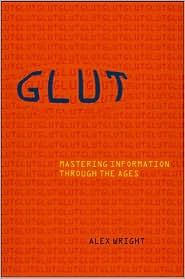
Glut by Alex Wright is basically about how people have categorized information throughout the ages, with an emphasis on how libraries have traditionally organized information. Overall while there were a few interesting bits of information that I gleaned from it, the book was too broad for me to really find interesting or useful. Except for a few passing references the book was also largely biased towards western Europe, and once the timeline got around to the birth of the United States, it was largely biased towards America.
One part that I did find interesting, however, was the part discussing the monastic art of memory and specifically the difference between memorizing facts and actual wisdom. To me it seems like this is one major way that the internet has changed learning. I'm too young to know what the education system was like before computers firsthand, but based on books that I've read written in previous decades or the past century it seems like the modern education system puts a lot less emphasis on memorizing by rote and more emphasis on analyzing information. Maybe this is partly due to the fact that we're in the "information age" so that it would be impossible to memorize everything that a person needs to know just to get along today. It's probably also partly due to the fact that it's so easy to look up information now that there's no need to memorize it. Recently when I've been hanging out with my friends and one of us can't remember something someone will just whip out their i phone and look up the answer immediately. Tools like Wolfram Alpha are making it even easier to look up basic facts. I know I've had teachers who have said something to the effect of "Don't bother memorizing the dates--you can look those up on wikipedia. I want you to be able to tell me the event's significance instead."
I think one of the most beneficial aspects of the internet is that it puts a whole lot of facts at your fingertips so that you don't have to memorize information. Now you can spend the time that you previously had to spend in memorizing something or looking something up drawing connections and thinking critically about the information instead. I think that libraries play an important role in this. I almost never see people use encyclopedias or dictionaries anymore because it's easier to look up basic facts online. Where the internet can often be lacking, however, is in intelligent analysis of those basic facts, and with more information available every day I think people need more help to make sense of all of it. This is where I think libraries can really help by providing books and articles that have gone through some sort of publishing or peer-review process to ensure its accuracy. What I've noticed in student presentations is that students have more information readily available, but they often have difficulty distinguishing the good information from the bad. (In one of my theatre history classes I remember a student got in an argument with my teacher when the teacher objected to her claim that there were cars in the Elizabethan period. She kept on pointing to some pages printed from the internet saying--"it's written right here!")
Overall I'd give this book a 3 out of 5 stars. If you know almost nothing about the subject, it might be a good introduction, but it was much too general for me.
Tuesday, August 25, 2009
Summary of "Academic libraries: 'social' or 'communal?'" for LIBR 200
In his article "Academic libraries: 'social' or communal?'" Jeffrey Gayton explores the use of academic libraries as a communal space and how the recent trend of converting libraries into a social space is detrimental to the communal environment. Gayton defines communal space in libraries as a place where students and faculty can go to quietly study next to others engaged in similar activity. He argues that introducing noisy, non-library related areas is detrimental to this type of activity not only in the sense that it uses up finite resources in terms of funds and space, but also in that it is difficult to properly separate these spaces and they are, by nature, incompatible.
To support his claims Gayton uses data that show that among libraries that have recently undergone renovation, libraries that devoted more space to traditional library use experienced higher increases in gate counts when compared to libraries that devoted more space to social areas such as cafes. Gayton also cites surveys that show the appreciation of students and younger faculty for communal library space.
I chose this article because in the academic library that I currently work at they recently announced plans to add a cafe to increase gate count. As it turns out the cafe is not going in after all because the announcement was made previous to approval by the health and safety people, which fell through. I was opposed to the idea from the beginning (but nobody listens to a lowly student assistant). Space concerns on campus have lead to several departments moving into the library and taking over space that was previously study space for the students. The cafe would have gone up in an area that is currently one of the few remaining designated "quiet study areas."
As a student assistant with access services I spend a lot of time in the stacks shelving or paging books and based on what I see on a daily basis what Gayton is saying makes sense. I have often been asked by students where the best place in the library is for quiet study and I always see a lot of students making use of the study carrels when in the stacks. There are complaints if someone makes noise in areas designated for quiet study. During finals week there is never enough study space, so I'm concerned over how much it has diminished over the past couple of years.
Gayton, J. (2008). Academic Libraries: "Social" or "Communal?" The Nature and Future of Academic Libraries. The Journal of Academic Librarianship, 34(1), 60-6. Retrieved August 25, 2009, from Library Lit & Inf Full Text database.
To support his claims Gayton uses data that show that among libraries that have recently undergone renovation, libraries that devoted more space to traditional library use experienced higher increases in gate counts when compared to libraries that devoted more space to social areas such as cafes. Gayton also cites surveys that show the appreciation of students and younger faculty for communal library space.
I chose this article because in the academic library that I currently work at they recently announced plans to add a cafe to increase gate count. As it turns out the cafe is not going in after all because the announcement was made previous to approval by the health and safety people, which fell through. I was opposed to the idea from the beginning (but nobody listens to a lowly student assistant). Space concerns on campus have lead to several departments moving into the library and taking over space that was previously study space for the students. The cafe would have gone up in an area that is currently one of the few remaining designated "quiet study areas."
As a student assistant with access services I spend a lot of time in the stacks shelving or paging books and based on what I see on a daily basis what Gayton is saying makes sense. I have often been asked by students where the best place in the library is for quiet study and I always see a lot of students making use of the study carrels when in the stacks. There are complaints if someone makes noise in areas designated for quiet study. During finals week there is never enough study space, so I'm concerned over how much it has diminished over the past couple of years.
Gayton, J. (2008). Academic Libraries: "Social" or "Communal?" The Nature and Future of Academic Libraries. The Journal of Academic Librarianship, 34(1), 60-6. Retrieved August 25, 2009, from Library Lit & Inf Full Text database.
Friday, August 14, 2009
Nil: A World Beyond Belief

At comic con I went to the SLG booth looking for more of the Rex Libris comics by James Turner that I bought there last year. Unfortunately they didn't have any loose-leaf comics, they only had a second bound collection. I would have bought this, but I had already bought over 2/3 of the comics in this collection in loose-leaf form at comic con the previous year, so I couldn't justify it to myself. Thankfully this lead me to buying another graphic novel by James Turner, Nil: A World Beyond Belief.
As much as I love Rex Libris (come on, what's not to love about a librarian who travels to other planets and dimensions in search of overdue library books?) I loved Nil even more. From the moment I checked the back and saw that it was a satire I was excited because nothing makes me happier than a good satire. When I bought the book and the cashier asked if I was an English major, I knew it was another good sign (My English major roommate testified that I was an honorary English major even if I got my degree in Theatre). By the time I started reading the book and a character responded to someone asking how he was with "We are surrounded by fools and incompetents! They are everywhere. Considering their ubiquitous nature it is a wonder society has not already collapsed." I was in love. Oh James Turner, you know how I like it!
 Nil is about a man living in a society of nihilists who becomes a fugitive and ends up on the front lines in the war against optimists. It's ridiculous and fantastical and that's why I love it. My favorite part is Turner's attention to detail. He populates the land with political posters and the like that lends an amusing sense of reality to this shamelessly unrealistic land. My favorite was a poster that read:
"The Way of Nature: Nature evolves through extermination, but our modern technological society, with its tradition of tolerance, liberty, and diversity helps keep millions of stupid, incompetent people alive. Help us restore the balance of nature and kill a stupid person. Return to nature. Eat your neighbor."
It had a giant smiley face on it. Delightful! If you found that poster as hilarious as I do, then this is certainly the book for you.
Summary of "The Family That Facebooks Together" for LIBR 203
For this assignment I read the article "The Family That Facebooks Together" by Douglas MacMillan. The article talks about online networking sites like Facebook that include special applications and features for families to connect with each other as well as sites like cozi that are specifially designed for such interactions. The group calendar and to do lists that are available at sites like these are apparently particularly popular. On Cozi it is even possible to drag items directly from ads on the site into a family shopping list. I thought that this was a particularly clever move on their part. Sites like these seemed interesting and I can see how the shared shopping list and calendar would be useful for a family that lives together.
MacMillan, D. (August 6, 2009). The Family That Facebooks Together...(INTERNET). Business Week Online, p.NA. Retrieved August 15, 2009, from General OneFile via Gale:
http://find.galegroup.com/ips/start.do?prodId=IPS
MacMillan, D. (August 6, 2009). The Family That Facebooks Together...(INTERNET). Business Week Online, p.NA. Retrieved August 15, 2009, from General OneFile via Gale:
http://find.galegroup.com/ips/start.do?prodId=IPS
Wednesday, August 12, 2009
LIBR 203:Personal Skills Assessment
Based on the assessments that I took (Is Online Right for You?, San Diego Community College, and eLearners Advisor) I am definitely ready to begin class work in an online environment. The SDCC survey concluded that I am "ready for online learning" and I scored a 97% e-Learning compatibility factor at the eLearners Advisor website. I use computers often at work and in my personal life. I bought a new laptop last year so that I've had time to get used to all its functions and I am very comfortable with it. I've also taken several online courses in my undergraduate career and have done well in all of them. I think this is because I am very good at setting deadlines for myself and sticking to them and I have excellent reading comprehension skills.
I think Ken Haycock made some good points in his colliquia about team work. I was a theatre major in undergrad, so I gained a lot of experience in working in teams. Putting on a play is a huge collaborative effort, but that's one of the reasons it's so rewarding. A lot of excellent ideas will come up in production meetings that individual designers or directors would never have thought of on their own. I think Haycock's discussion of the five dysfunctions of team was very interesting. Based on my experience trust can be especially important in team work, especially in theatre where so many things can go wrong in a live performance. That's why so many troupes take time to do specific trust-building exercises.
Enid Irwin also had a good point when she talked about how important attitude can be when working on teams. I've definitely had encounters with people who exemplified all of the "disastrous behaviors," but I've noticed that positive attitudes in teams can be just as infectious as these negative outlooks, so rather than letting these "disastrous behaviors" pull me down I try to lift the persons displaying these traits with encouraging words. I hope I'll be able to apply some of what I've learned working on a production team to my online classes to help create successful teams.
I think Ken Haycock made some good points in his colliquia about team work. I was a theatre major in undergrad, so I gained a lot of experience in working in teams. Putting on a play is a huge collaborative effort, but that's one of the reasons it's so rewarding. A lot of excellent ideas will come up in production meetings that individual designers or directors would never have thought of on their own. I think Haycock's discussion of the five dysfunctions of team was very interesting. Based on my experience trust can be especially important in team work, especially in theatre where so many things can go wrong in a live performance. That's why so many troupes take time to do specific trust-building exercises.
Enid Irwin also had a good point when she talked about how important attitude can be when working on teams. I've definitely had encounters with people who exemplified all of the "disastrous behaviors," but I've noticed that positive attitudes in teams can be just as infectious as these negative outlooks, so rather than letting these "disastrous behaviors" pull me down I try to lift the persons displaying these traits with encouraging words. I hope I'll be able to apply some of what I've learned working on a production team to my online classes to help create successful teams.
Monday, August 10, 2009
Fahrenheit 451
The Ray Bradbury panel got me thinking about Fahrenheit 451, which I read about a month ago. I read it in a day, it was actually the same day as my last day working at The Book Shop before the owner sold it and retired.
I miss The Book Shop, I had some good customers there and I certainly miss the employee discount, but what I miss most is hanging out with the owner, Hank, gossiping all weekend. What more could I ask for than good books, good company, and good gossip!
My last day there was particularly odd. About an hour before the shop was supposed to close the lights turned off and Hank couldn't get the landlord on the phone to turn them back on so we just closed early. It was the last Sunday in June and it was sweltering hot. I started the book at work, then finished it after going out for ice cream while I was lying on my bed with an ice pack on my head because we don't have air conditioning and I was trying desperately to cool down. All together, I think it was a pretty good setting for reading this book.
Despite the number of 'classics' that I've read and loved I'm still surprised when I read one that truly engages me and keeps me turning the pages. I guess society's prejudice that classics have to be time consuming works that require serious concentration and thought to appreciate is just too prevalent to be avoided. I immediately fell in love with Clarisse, and I soon began to be absorbed by this story of a dystopian society in which people who owned books were outlaws. I think it was Bradbury's biographer who pointed out in the panel that with ipods and blue tooth the idea of people being constantly bombarded with noise and distracted by 'seashells' seems more relevant than ever.
I'm not going to bother with a full review of the book because I'm pretty sure that everyone out there knows it well enough. I would, however, like to briefly talk about a few passages that stood out to me. The first is one of the best arguments that I've found about why printed books will survive the kindle:
"Do you know why books such as this are so important? Because they have quality. And what does the word quality mean? To me it means texture. This book has pores. It has features. This book can go under the microscope. You’d find life under the glass, streaming past in infinite profusion. The more pores, the more truthfully recorded details of life per square inch you can get on a sheet of paper, the more ‘literary’ you are. That’s my definition, anyway. Telling detail. Fresh detail. The good writers touch life often. The mediocre ones run a quick hand over her. The bad ones rape her and leave her for the flies. "
I think that more than anything else this is why books will survive. Because there is a physical quality and weight and smell and feel to books that can never be replicated by the pristine slickness of electronics. The kindle will never replace the books I have from my grandmother with her hand-written notes in the margin and yellowing pages and creased spines. They will never replace the books we got at The Book Shop with old pictures shoved in as book marks or inscriptions like in my copy of Time Traveler's Wife: "Passion & Obsession. The one thing you cannot live without is love. Never stop believing." dated February 14th, 2006. I bought the book in June of 2007. If that's not a perfect reminder of reality to accompany a romance novel I don't know what is! I'm not naive, I know that e-readers are becoming more and more popular and that they won't disappear any more than physical books, but new technology rarely entirely replaces the old. Some bands still come out with vynil versions of their albums for goodness' sake!
The second quote seems particularly apt to me considering the times that we are in.
"We are living in a time when flowers are trying to live on flowers, instead of growing on good rain and black loam. Even fireworks, for all their prettiness, come from the chemistry of the earth. Yet somehow we think we can grow, feeding on flowers and fireworks, without completing the cycle back to reality. Do you know the legend of Hercules and Antaeus, the giant wrestler, whose strength was incredible so long as he stood firmly on the earth? But when he was held, rootless, in midair, by Hercules, he perished easily. If there isn’t something in that legend for us today, in this city, in our time, then I am completely insane."
I work as a Student Assistant at a CSU library, and we just had our first furlough day today. Of course the library couldn't close if classes were in session so we opened with half staff and no other offices open to refer students to. We've also been closing an hour earlier every day than we did last summer, and it will only get worse before it's over. I just graduated from there in fall, so I'll have to find a new job soon. The job hunt hasn't been particularly encouraging so far because most libraries, as state-funded institutions, simply can't afford to hire any new people right now even if other people leave. I know we'll survive this economic down turn because, well, what choice do we have? But it makes me wonder how much damage we'll be doing in the meantime by cutting the funding and services at our schools and libraries.
The last quote is a bit more optimistic:
"The difference between the man who just cuts lawns and a real gardener is in the touching…The lawn cutter might just as well not have been there at all; the gardener will be there a lifetime."
I'm starting grad school for my Masters of Library and Information Sciene soon and it's quotes like this that make me glad that I am, even though tuition is killing me! I truly believe that as a librarian I will be able to touch people's lives and make them better. We all have a responsibility to help in the way that we are best equipped for, and the more I work in libraries the more I feel that it is where I belong. I know that a lot of the patrons may just be looking for a book to finish their report that they waited until the last minute to start, or even just looking for the restroom, but even if I touch just one person's life in my whole carreer I'll feel like my time at library school was well spent.
P.S.If you want a tangentially-related laugh, check out this comic.
I miss The Book Shop, I had some good customers there and I certainly miss the employee discount, but what I miss most is hanging out with the owner, Hank, gossiping all weekend. What more could I ask for than good books, good company, and good gossip!
My last day there was particularly odd. About an hour before the shop was supposed to close the lights turned off and Hank couldn't get the landlord on the phone to turn them back on so we just closed early. It was the last Sunday in June and it was sweltering hot. I started the book at work, then finished it after going out for ice cream while I was lying on my bed with an ice pack on my head because we don't have air conditioning and I was trying desperately to cool down. All together, I think it was a pretty good setting for reading this book.
Despite the number of 'classics' that I've read and loved I'm still surprised when I read one that truly engages me and keeps me turning the pages. I guess society's prejudice that classics have to be time consuming works that require serious concentration and thought to appreciate is just too prevalent to be avoided. I immediately fell in love with Clarisse, and I soon began to be absorbed by this story of a dystopian society in which people who owned books were outlaws. I think it was Bradbury's biographer who pointed out in the panel that with ipods and blue tooth the idea of people being constantly bombarded with noise and distracted by 'seashells' seems more relevant than ever.
I'm not going to bother with a full review of the book because I'm pretty sure that everyone out there knows it well enough. I would, however, like to briefly talk about a few passages that stood out to me. The first is one of the best arguments that I've found about why printed books will survive the kindle:
"Do you know why books such as this are so important? Because they have quality. And what does the word quality mean? To me it means texture. This book has pores. It has features. This book can go under the microscope. You’d find life under the glass, streaming past in infinite profusion. The more pores, the more truthfully recorded details of life per square inch you can get on a sheet of paper, the more ‘literary’ you are. That’s my definition, anyway. Telling detail. Fresh detail. The good writers touch life often. The mediocre ones run a quick hand over her. The bad ones rape her and leave her for the flies. "
I think that more than anything else this is why books will survive. Because there is a physical quality and weight and smell and feel to books that can never be replicated by the pristine slickness of electronics. The kindle will never replace the books I have from my grandmother with her hand-written notes in the margin and yellowing pages and creased spines. They will never replace the books we got at The Book Shop with old pictures shoved in as book marks or inscriptions like in my copy of Time Traveler's Wife: "Passion & Obsession. The one thing you cannot live without is love. Never stop believing." dated February 14th, 2006. I bought the book in June of 2007. If that's not a perfect reminder of reality to accompany a romance novel I don't know what is! I'm not naive, I know that e-readers are becoming more and more popular and that they won't disappear any more than physical books, but new technology rarely entirely replaces the old. Some bands still come out with vynil versions of their albums for goodness' sake!
The second quote seems particularly apt to me considering the times that we are in.
"We are living in a time when flowers are trying to live on flowers, instead of growing on good rain and black loam. Even fireworks, for all their prettiness, come from the chemistry of the earth. Yet somehow we think we can grow, feeding on flowers and fireworks, without completing the cycle back to reality. Do you know the legend of Hercules and Antaeus, the giant wrestler, whose strength was incredible so long as he stood firmly on the earth? But when he was held, rootless, in midair, by Hercules, he perished easily. If there isn’t something in that legend for us today, in this city, in our time, then I am completely insane."
I work as a Student Assistant at a CSU library, and we just had our first furlough day today. Of course the library couldn't close if classes were in session so we opened with half staff and no other offices open to refer students to. We've also been closing an hour earlier every day than we did last summer, and it will only get worse before it's over. I just graduated from there in fall, so I'll have to find a new job soon. The job hunt hasn't been particularly encouraging so far because most libraries, as state-funded institutions, simply can't afford to hire any new people right now even if other people leave. I know we'll survive this economic down turn because, well, what choice do we have? But it makes me wonder how much damage we'll be doing in the meantime by cutting the funding and services at our schools and libraries.
The last quote is a bit more optimistic:
"The difference between the man who just cuts lawns and a real gardener is in the touching…The lawn cutter might just as well not have been there at all; the gardener will be there a lifetime."
I'm starting grad school for my Masters of Library and Information Sciene soon and it's quotes like this that make me glad that I am, even though tuition is killing me! I truly believe that as a librarian I will be able to touch people's lives and make them better. We all have a responsibility to help in the way that we are best equipped for, and the more I work in libraries the more I feel that it is where I belong. I know that a lot of the patrons may just be looking for a book to finish their report that they waited until the last minute to start, or even just looking for the restroom, but even if I touch just one person's life in my whole carreer I'll feel like my time at library school was well spent.
P.S.If you want a tangentially-related laugh, check out this comic.
Subscribe to:
Posts (Atom)