Showing posts with label Bildungsromans. Show all posts

Wednesday, March 16, 2016

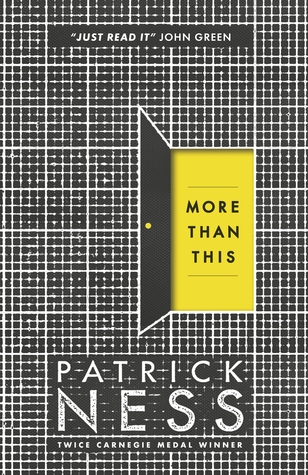
More than this Review

More Than This

Book talk: Seth feels the impact of a rock against his head as the waters close in around him and he drowns. He dies in America, but he wakes up again in his childhood home in England. His neighbors' houses are exactly how he remembers them, except that nobody's home. He ventures into town for supplies and finds that nature has begun to reclaim the town with wild plants and animals. It's like nobody has lived there for years. He thinks he's in his own personal afterlife until he finds two others like him and a mysterious enemy that is hunting them all down.

Rave: I always go into Patrick Ness novels expecting death, so I was actually a bit relieved when it came at the very beginning. I had hoped that would remove some of the suspense and eventual emotional devastation--oh how wrong I was! I think talking too much about the plot will just ruin it for people who haven't read it yet so I'll just say that I love the diversity of the characters, their layers that are revealed as the plot progresses, and the mind-trip that was the ever-twisting plot.

Every book its reader: I'd give this to fans of both plot-focused science fiction like the Matrix and fans of realistic books about teens dealing with surviving all-too-real trauma. It can get pretty intense at times so I'd say 8th grade and up.

Topics and Trends: death, abuse, trauma, science-fiction, immigration, guilt, post-apocalyptic, thriller, diversity

Extras:
There's a website for the book and a couple of great videos


Bonus Quote:
“Know yourself and go in swinging.”

Source: kobo ebook

More than this by Patrick Ness: buy it or check it out today!

Friday, February 12, 2016

Aristotle and Dante Discover the Secrets of the Universe Review

Aristotle and Dante Discover the Secrets of the Universe

Book talk: "The problem with my life was that it was someone else's idea" Ari never asked to be born into a family where everyone is bursting with words left unsaid. His father never left Vietnam behind and his brother is in jail, meaning that all the family pressure is on him to be the good kid. He never asked to be saddled with a name like Aristotle. But his life finally starts to make sense when he meets a boy named Dante. Dante is unabashedly himself--emotional, vulnerable, intelligent, beautiful. Aristotle never felt like he fit in before but he feels a sense of belonging when he's with Dante. Their friendship blooms until Aristotle's own secrets threaten the only happiness he has ever known.

Rave: This book was written by a poet, and that is immediately obvious because the prose is just gorgeous. The plot is fairly quiet, mostly dealing with the inner life of the narrator as he comes to terms with his various emotions, but I read it in a greedy gulp anyway. Not only are Dante and Aristotle painted in heart-breaking detail but the other characters such as their parents are portrayed with complexity and in a way that actually renders them helpful and meaningful players in their children's lives. Highly recommended!

Every book its reader: I'd give this to teens 7th grade and up looking for an emotional novel or a moving romance.

Topics and Trends: LGBTQ, romance, characters of color, poetry,

Bonus Quotes:

"The problem with my life was that it was someone else's idea"

"Yeah, I had all kinds of tragic reasons for feeling sorry for myself. Being 15 didn't help. Sometimes I thought that being 15 was the worst tragedy of all"

"We sat, drinking our tea and watching the rain fall on his front porch. The sky was almost black and then it started hailing. It was so beautiful and scary, I wondered about the science of storms and how sometimes it seemed that a storm wanted to break the world and how the world refused to break."

“Words were different when they lived inside of you.”

“To be careful with people and with words was a rare and beautiful thing.”

“But love was always something heavy for me. Something I had to carry.”

“Summer was here again. Summer, summer, summer. I loved and hated summers. Summers had a logic all their own and they always brought something out in me. Summer was supposed to be about freedom and youth and no school and possibilities and adventure and exploration. Summer was a book of hope. That's why I loved and hated summers. Because they made me want to believe.”


Source: school library

Aristotle and Dante Discover the Secrets of the Universe by Benjamin Alire Saenz: buy it or check it out today!

Sunday, February 22, 2015

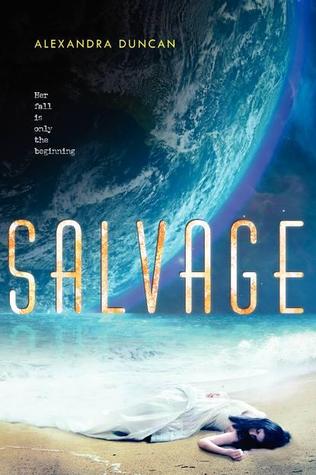
Salvage Review

Salvage

Book talk:  Ava dreams of Earth, but she has never set foot on solid land.  She lives on a Crewe ship where everyone knows their place and there's plenty of work to do.  She longs to learn how to fix things or go down to Earth, but that's men's work.  Women have their own work like tending animals and children or cooking and doing laundry.  The other women tell her that the longing for Earth and other things she can't have will go away once she gets married and starts having children.  As the captain's daughter the odds are good she'll make a fine match--maybe even as a first wife.  But just when everything seems to be coming together disaster strikes, and she has to flee everything she has ever known for the perils of a life on land.  

Rave: How could I not be intrigued by the premise of polygamists in space?  Reading about this society with its mythology and social constructs was fascinating in and of itself.  And that's just the beginning of the fully developed settings Ava lives in. For a while she lives with a single mom in a house on stilts over a giant mass of garbage in the Pacific Ocean and later she spends a good deal of time in India both in the slums and a posh suburb.  Being able to compare and contrast these very different settings and the characters that populate them was one of my favorite parts of reading the novel.  The characters are as richly layered and diverse as the settings and had a way of staying with me.  The overall effect reminded me of the TV show Firefly.  It's set in the future and largely in space and there are aspects that are advanced and shiny but a lot of it is gritty and hasn't changed much from today.  Moreover I loved the unconventional way romance is dealt with in the novel and how long it takes for Ava to come to terms with her past.  Character growth is slow and there are no magic wands to fix her problems (which just keep coming at alarming speed.)

Every book its reader:  I'd give this to fans of gritty space dramas like Firefly and readers drawn to rich settings with well-rounded characters.  The romance gets pretty intense especially at the beginning of the novel and there's a fair amount of violence and disturbing situations Ava finds herself in.  I'd say it's best for 8th grade and up.

Bait & hooks: outer space, competent adults, feminism, protagonist of color, economic diversity, set in a foreign country (India), moral ambiguity, strong characters, strong world building, gritty setting, unconventional romance

Extras:

Alexandra Duncan has her own website subtitled "Science Fiction. Fantasy. Feminism." love it!

Source: ebook from public library

Salvage by Alexandra Duncan: buy it or check it out today!

Friday, August 15, 2014

The Vine Basket review

The Vine Basket

Book talk:  What would you do if you were not allowed to go to school? Ever since her older brother left, Mehrigul has to accompany father to market and watch the stall while he goes away to gamble and chat with friends.  At home she often has to take control of the household chores while her mother is laid out with headaches.  She misses school, and she misses her brother even more, but at least if she works hard perhaps she can keep her younger sister in school and make a good life for herself.  Mehrigul never thought that she had anything special to offer the world anyway, until an American lady sees a vine basket she made and buys it.  She promises to return in a month and buy any more baskets Merigul can make.  Her father doesn't approve, so she has to hide her basket weaving in between chores.  Then things go from bad to worse when the local authorities realize that she's no longer in school and threaten to send her away to work in a factory.

Rocks my socks:  I had never even heard of the Uyghur people before reading this book, so I was excited to learn about a new culture.  The details of how they have adapted to life in their harsh climate were fascinating, but the reason I love this book so much is Mehrigul.  She is a completely endearing character and is so fully fleshed out that she felt very real to me.  All of her insecurities and guilt over small transgressions are laid bare.  She works so hard to achieve her goals that it is heartbreaking when she encounters set backs.  I enjoyed the descriptions of what it felt like to make the baskets with her own hands from the frustration when something wasn't working out to the pride she felt over the finished product.

Rocks in my socks:   I can be leery of books about an ethnic group written by someone from outside that group, but La Valley really seems to have done her research and was careful to consult Uyghur people as she worked on the novel.  Mostly I am just glad that this story that may have otherwise never been told was written.  The fact that it's an American lady who has to come in and save someone from another culture is a bit troubling, but given the circumstances seems realistic and at least the American only plays a periphery role, helping Mehrigul to make her own life better.

Every book its reader:  I'd give this to anyone looking for a contemporary novel set in another culture or those looking for a heartwarming story of a girl overcoming difficult odds.  The conditions Mehrigul live in are harsh but there's no graphic violence and no romance.  I'd say it's fine for 5th grade and up.

Extras:

Josanne La Valley has a website with more information about herself, the book, and the Uyghur people: http://www.josannelavalley.com/index.html

Readers might enjoy this video of Uyghur artisans at work:


Source: school library

The Vine Basket by Josanne La Valley: buy it or check it out today!

Thursday, February 20, 2014

The Girl With Borrowed Wings Review

The Girl With Borrowed Wings

Book talk: Have you ever wished that you had wings?  Have you ever imagined what it would be like to be able to fly away any time that you wanted, and go anywhere you wished?  Frenenqer has been many places and lived in many countries, but she has never felt free.  Even when her father's not there Frenenqer can feel the pressure of his expectations like a tug on her spine leading her wherever he wants her to go.  So she contents herself with small rebellions like reading books and dreaming of wings while she's trapped in her bedroom in the middle of the desert.  She never thought that she could escape her father until she met a Free person.  Regular laws of the universe do not apply to Free people.  They can shape shift into anything they want and fly all over this world and others.  The moment Frenenqer meets Sangris, she knows that he will only lead to trouble and that her father would want her to turn him away.  But she can't resist the temptation of his wings. For once she ignores the tug on her spine and doesn't do what her father would want, whatever the consequences may be.  

Rocks my socks:  This book has everything that I love in a novel: foreign countries, bookish protagonists, themes of independence and individualism, an "interestingly wicked" love interest,  talking cats, and heaping helpings of sass!  I don't think I could have crafted a book that was better suited to my tastes.  I enjoyed hearing about all the countries Frenenqer had lived in, her best friend was charmingly quirky and supportive, and I love the way she grew over the course of the novel so that she could embrace who she is and stand up for herself.  Her father was the most disturbing antagonist I've seen in a long time as he controlled his household and psychologically abused his wife and daughter.  The man/cat on the other hand was absolutely delightful as he wooed Frenenqer and waited for her to be able to return his affections while patiently enduring her sarcastic barbs.  He reminds me a bit of Spike in the later seasons of Buffy.  I absolutely devoured this book and enjoyed myself immensely while doing so.

Rocks in my socks:  zip

Every book its reader:  I'd give this to urban fantasy fans and those who enjoy books about other cultures.  Fans of literary bad boys will particularly enjoy Sangris.  The romance is pretty conservative and there's little violence although the scenes that describe the emotional abuse Frenenqer receives can be disturbing.  I'd say it's fine for 6th grade and up.

Extras:

Rinsai Rossetti has a website

Source: school library

The Girl With Borrowed Wings by Rinsai Rossetti: buy it or check it out today!

Friday, January 3, 2014

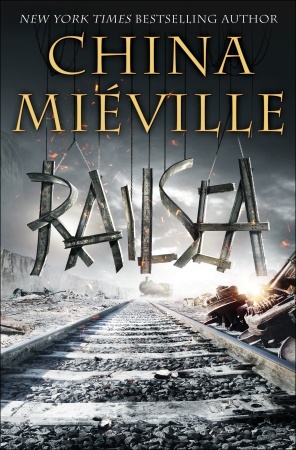
Railsea Review

Railsea

Book talk: Life on the railsea is not easy: bad tracks, traps laid by pirates, and attacks from below claim many lives.  But Sham is grateful for his job aboard the Medes.  At least he is finally seeing the world outside his home town.  Hunting giant moles can be exciting and people say that he should be proud to serve under a captain with her own Philosophy--an ivory colored creature she pursues with a passion and who has already taken her arm.  Sham wants something more though and his vague sense of unease finds a focus when he discovers a picture of the impossible: a place where the great tangle of the railsea condenses into a single track. But while the captain's nemesis is certainly deadly, Sham soon discovers that secrets are the most dangerous quarry of all.

Rocks my socks:  The world-building in this novel was the most creative and thorough I have read in a while.  The way the environment has changed affects everything from how people earn a living to what creatures exist to the written and spoken language.  Whole industries have cropped up around salvaging technology from the more prosperous past and the pollution that has seeped into the ground has created mutant creatures that thrive in the empty wastelands between cities.  The captain is reminiscent of Captain Ahab, but the story isn't a simple re-working of Moby Dick.  In this world there are many captains like Ahab and it's become a trend to have a 'philosophy,' a specific creature that has wronged a captain and which the captain has sworn to hunt until one or both of them dies.  They often gather at pubs to tell their stories and there's a museum to chronicle the captains who have been successful in their philosophy hunts.  This is only part of the story of Railsea though, and Mieville mainly includes it to lambast the idea.  I am a fan of books that use slang and dialect to help set an atmosphere for a story so I loved the language in this novel and how connected it is to the world-building.  There were many distinctive characters to enjoy as well and I naturally enjoyed the fact that Sham nurses a bat that becomes his companion and helps him along the way.

Rocks in my socks:  Mieville is a wonderful and highly opinionated author, but he doesn't always weave those opinions in seamlessly.  He was far from subtle in the points he wanted to make, and it often felt preachy to me.  After a lengthy book where I got attached to the characters and lost in their world the end was basically just a cheap shot about the greed of big businesses.  I don't necessarily disagree with him, but making that the climax made the whole plot seem cheap and pointless.  Even though I absolutely adored most of the novel, the ending left me with such a bad taste that it soured the whole novel for me.

Every book its reader:  I'd give this to science fiction fans looking for something with intricate world-building or those looking for a new take on Moby Dick.  The world-building, though wonderfully imaginative, throws you in the deep end instead of slowly acclimating you.  This, combined with the dialect make it difficult to get into, so I'd save it for more advanced readers. It can be violent at times, so I'd save it for 7th grade and up.

Extras:

China Mieville has his own site

There's an interview with Mieville about the book on Boing Boing

There's a trailer for the book, although I'm not sure how well comparing the book to Moby Dick will sell it to teens:


Source: school library

Bonus Quotes: 

“People have wanted to narrate since first we banged rocks together & wondered about fire. There’ll be tellings as long as there are any of us here, until the stars disappear one by one like turned-out lights.”


“Humans like nothing more than to pigeonhole the events & phenomena that punctuate their lives.”


“There was a time when wen we did not form all our words as we do now, in writing on a page. There was a time when the word "&" was written with several distinct & separate letters. It seems madness now. But there it is, & there is nothing we can do about it.

Humanity learned to ride the rails, & that motion made us what we are, a ferromaritime people. The lines of the railsea go everywhere but from one place straight to another. It is always switchback, junction, coils around & over our own train-trails.

What word better could there be to symbolize the railsea that connects & separates all lands, than “&” itself? Where else does the railsea take us, but to one place & that one & that one & that one, & so on? & what better embodies, in the sweep of the pen, the recurved motion of trains, than “&”?

An efficient route from where we start to where we end would make the word the tiniest line. But it takes a veering route, up & backwards, overshooting & correcting, back down again south & west, crossing its own earlier path, changing direction, another overlap, to stop, finally, a few hairs’ width from where we began.

& tacks & yaws, switches on its way to where it’s going, as we all must do.”

Railsea by China Mieville: buy it or check it out today!

Tuesday, August 27, 2013

Matched Review

Matched (Matched, #1)

Book talk:  The world used to be a horrible place, but Society has changed all that.  Society guides each of its citizens down the optimal path: choosing their careers, their houses, and even their spouses.  Society is all that keeps them from the diseases, crimes, and wars of the past.  Cassia is a bit nervous on the way to her Match Banquet, but she knows that Society will choose the ideal match for her and keep her safe.  But then Society makes a mistake, and she realizes that there is more than one path that she could follow, and more than one match she could choose.  Making her own choices means risking everything, but how can she keep trusting Society to choose for her when she discovers the dark secrets they've been hiding?

Rocks my socks: I admit that I judged this book by its cover and wrote it off as another fluffy love triangle series.  Then I needed an audiobook for a last minute road trip with my sister.  I ended up being pleasantly surprised by the depth of the novel and the extent of the world-building.  Even the love triangle served the plot without eclipsing it.  It triggered important actions by the characters, but it was not the whole point of the novel.  Add to this the refreshing addition of parents that are loving and not completely useless, an allusion to Sisyphus (one of my favorite myths), and the fact that the poem "Do Not Go Gentle" (another favorite) was a pivotal to the story and you get a surprisingly refreshing novel that thoroughly entertained my sister and I through vast stretches of Arizona desert.

Rocks in my socks:  The book was predictable at times and strongly reminiscent of The Giver.  Both societies create order by eliminating choice of career, spouse, etc.  Both work to destroy memories of the past and euthanize the elderly at a certain age. Still, Matched provides plenty of details that differentiate it.  Besides, the question of how much freedom people would be willing to give up to ensure their safety is one American society has been grappling with for a long time. Benjamin Franklin famously cautioned "Those who would give up Essential Liberty to purchase a little Temporary Safety, deserve neither Liberty nor Safety."  The question remains relevant today as I was often reminded this summer as I travelled and submitted sheepishly to the TSA.  The recent controversy around the Patriot Act has also caused many to question how many civil liberties we are willing to give up for the sake of the safety of society.  So if another book gets today's teens talking about this very question then that's not a bad thing.

Every book its reader:  I'd give this to fans of other YA dystopias like The Hunger Games, although this one is more character than plot focused so those just looking for something dark and violent should look elsewhere.  The book is far less violent than most of the dystopian books out there and Society keeps such close tabs on the characters that it never gets too steamy either.  I'd say it's fine for 6th grade and up.

Extras:

Ally Condie has her own site with the usual blog, FAQ, bio, etc as well a play list of suggested songs for your listening pleasure

The series has its own official website with information about the books and a party pack pdf download with suggestions for throwing your own themed party (including a quiz you can take to see where the dystopian Society would place you.  The marketing department seems to have missed the point of the novels.)

There is also a fansite where you can get info on the books, the author, the upcoming movie, and quotes.

If that isn't enough for you head on over to the tumblr for more quotes, fan art, and other images related to the book.

If you want even more you can head on over to the wiki and get involved in the fan community.

There's an official trailer for the book that's appropriately ominous:


Those who have read the book may appreciate this recording of Dylan Thomas reciting "Do Not Go Gentle"


And to round the media extravaganza off, here's a scene from The Muppet Show where Fozzie attempts to recite another poem mentioned in the novel, Robert Frost's "Stopping By Woods on a Snowy Evening" (stay through the end because Statler and Waldorf's pun is my favorite part)


Bonus Quote:
“Growing apart doesn't change the fact that for a long time we grew side by side; our roots will always be tangled. I'm glad for that.”

Source: Audiobook from a public library

Matched by Ally Condie: Buy it or check it out today!
Tuesday, March 26, 2013

Ash Review


Book talk:  Ash should have known better.  And perhaps she would have, if her mother had lived long enough to teach her the old ways.  But her mother did not live and she did not learn, so she spent nights by her graveside, attracting the attention of fairies.  Fairies may be beautiful and alluring, but they have little regard for human life and can be very dangerous.  For most people, attracting their attention would be disastrous, but for Ash fairies are the least of her problems.  When her father died soon after her mother, she was taken from her home to live as a servant to her step mother and sisters.  When life is barely worth living, you don't mind a little danger.  Then, Ash meets someone that makes her glad to be alive and she risks it all for one night of happiness, for a ball.  Will she be able to break free of all who make claims on her and be home before the magic wears off?

Rocks my socks:  Reading Ash was like discovering the Cinderella story all over again.  The world was similar to the classic fairy tale setting, but far richer.  Everything in the story is on edge.  The world is shifting from an age of magic to an age of reason.  Fairies still exist, but they are not what they used to be. Ash's family life keeps reaching the edge and toppling over only to regain its balance and topple once more. The huntress class straddled two worlds as well.  I enjoyed seeing how this strong female leader was necessary in the typically masculine hunting rite while other women in society remained relatively powerless. My favorite thing about the novel was the way Lo took a traditional fairy tale and subverted the assumptions that went along with it.  In most stories the supernatural figure that stalks the female lead creepily for years would be the love interest.  Or the handsome prince that falls for the lowly servant girl.  But by having Ash fall in love with someone else, someone who makes her feel strong and encourages her to pursue her strengths instead of someone looking to protect her so she can remain weak, Lo shows us just how messed up many of these traditional stories are.

Rocks in my socks: As much as I love all the added world-building and new plot developments, when I sit down to read a Cinderella story I expect to spend a fair amount of time at a ball.  The beginning of the book had a very languid pace while not much was happening, which I didn't mind except that as more things began happening the narration went too fast and glossed over events.  It seems like the reader is privy to everything that happens to Ash at the ball, but if that's true she hardly spends any time there.  Considering how much she's risking to go there it doesn't seem worth it.  Can't I have a modern feminist slant and long descriptions of pretty dresses and dancing?  Is that too much to ask?

Every book its reader:  I'd give this to fans of fairy tales retold and strong female leads.  It's also a great book for anyone looking for GLBTQ fantasy.  The violence and romance are mostly implied, so I'd say it's safe for 6th grade and up.

Extras:

Malinda Lo has a great website with a blog, a bio (with a picture of her adorable dog), and more

Lo's site also has a page specifically for Ash with an FAQ, map, playlist for the book, etc.

Malinda Lo has a trailer for the book:


There's a great fan trailer as well:


Source: Purchased

Ash by Malinda Lo: Buy it or check it out today!

Thursday, March 21, 2013

Endangered Review


Book talk:  Sophie knew that she shouldn't interfere, but when she saw him on the side of the road, she had to stop.  He was still a baby, but it was clear that he had been restrained with ropes recently and he was covered with sores and bald patches.  Why, out of all the suffering she had seen that day in the Congo, this was the sight that moved her to act she'll never know.  But one thing is for sure: that baby bonobo would change her life just as much as she'd change his.

Rocks my socks:  I am a complete sucker for any story involving apes, so it's impossible for me to provide a review on this book that is by any means impartial.  That said, I absolutely loved it.  From all the time Sophie ends up spending with the Bonobos and the way their social dynamic is described to the way Schrefer resists painting issues like bushmeat trade as black-and-white and instead highlights the complications and lack of easy answers regarding the political issues plaguing the Democratic Republic of Congo.  I remembered hearing about conflict in the area as a side note when studying apes as a child, but this is the first book I've read that ties in the problems facing the humans with those facing their hairier cousins, and does it well.  It was very impactful to read about a dystopian situation that so closely resembles actual events after reading so many far-fetched science fiction ones.  The book isn't necessarily more violent than something like The Hunger Games, but it is far more realistic, which makes it all the more chilling.

Rocks in my socks:  It's a minor complaint, but the first person perspective of the book means that in order to show all the complexities of the region, our narrator has to experience a lot personally.  To believe that she went though everything she did stretches credulity a bit, but stranger things have happened in reality I'm sure.

Every book its reader:  I'd give this to fans of animal stories or dystopias.  The plot quickly resembles the kind of survival fiction under a corrupt regime that is so popular in YA fiction today, all while maintaining a strong connection to what is happening with the bonobos to keep animal lovers involved.  The book isn't sensationalistic and if anything perhaps less violent than would be realistic given the situation, but it is still has a lot of violence and death involved.  It isn't for the faint-hearted.  I'd save it for 8th grade and up.

Extras:  


Watch Eliot Schrefer talk about the book and play with adorable bonobos!


Eliot Schrefer also has a website with information about him and the book

The National Book Foundation has a page for the book with extras

Endangered is a contender in this year's Battle of the Kids' Books

Source: school library

Endangered by Eliot Schrefer: Buy it or check it out today!

Sunday, December 9, 2012

Tiger Lily Review


Book talk:  Neverland is not the fantasy you know it as.  It's an island in the Atlantic that few know how to visit.  Because of its isolation, there are creatures there that cannot be found anywhere else, creatures like mermaids and fairies.  It's one of those creatures, Tinkerbell, who tells us the story of Tiger Lily as she saw it.  Her story is not one of childhood dreams and happy endings.  Neverland can be a dangerous place, and if you're not careful the island will eat you alive.  But for Tiger Lily the most dangerous things on the island are not the native hazards, but the foreigners who wash-up and make the island their home.  Foreigners like the infamous Peter Pan.

Rocks my socks:  This is one of the best re-tellings of a story that I've read.  All of the familiar characters are there, but what were two dimensional archetypes in the original story have been transformed into layered characters with interesting new histories that inform their every move.  Even Captain Hook gets a new back story that lends him some human interest and sympathy: his hand was not eaten by a crocodile "it came off in an assembly line...I was staying up nights to study. I thought I could study my way into being a gentleman. Well, I fell asleep. My hand went in instead of the leather."  Smee, on the other hand, is transformed from a bumbling idiot into a psychopath who literally gets away with murder because he looks so innocuous.

The story is full of outsiders with Tiger Lily and her best friend described as "both misfits or, as I liked to think of them, strange exotic birds, one too fierce to be hemmed in as a girl, and the other too hesitant to be respected as a boy."  My favorite of the new characters introduced in this book is Tik Tok, the medicine man who adopted Tiger Lily as a child.  He wears dresses, grows his hair long, and engages in women's activities instead of hunting with the men.  Everyone in the island accepts him for who he is without a second-thought--that is until an Englishman washes ashore and begins to convert the islanders.  His story is the most heart-wrenching in a novel that is ultimately about heartbreak.  Tinkerbell loves Peter Pan, but she cannot communicate with him even if the difference in their size could be overcome. Tiger Lily is torn between her love of her father and her tribe and her growing affection for Peter, but knows that she can't have both.  Peter senses these difficulties but ignores all his problems in hopes that they'll go away.

Wendy is one of the few characters that isn't presented as vulnerable and broken:  "She had the blissful confidence of someone who had never been put in a pot of turkey broth to die." I think the quote that best describes her though is "She held her skirts against her legs as they walked, making sure to slowly avoid this tiny briar and that muddy boggy spot, for out of all the things in the forest, she noticed her dress the most."  Perhaps this is why she is so attractive to Peter: in an island of misfits she stubbornly insists on molding her surroundings to suit her so that she always belongs.  For the rest of the characters things do not work out as well.  The emotions of the novel are as raw and wild as the Neverland forest: characters act in haste, they make mistakes, they betray each other.  That is precisely why I loved this novel so much.  There are enough stories about people who can do no wrong and love that conquers all.  But unfortunately we are not all Wendys and life doesn't always work like that.  This is a story is for the misfits, for the failed romances, for the voices that are silenced.  This is Tiger Lily's story so it doesn't take Peter's advice and ignore things that are difficult or unpleasant.  I loved it for that, even if it made bawl harder than I have in a long time.

Rocks in my socks:  The only thing that nagged at me was that despite beginning with a warning that things will not end well, Anderson takes a lot of time at the end of the novel describing the rest of the lives of the characters and tying up loose ends to show that everyone was ultimately more or less happy.  I wish some of that had been edited down.  I'm not a fan of lengthy goodbyes in real life or bloated denouements in fiction.

Every book its reader:  I'd give this to people who like darker retellings of classic stories.  Fans of Wicked Lovely and Tender Morsels should enjoy this modern perspective on Peter Pan.  It's definitely more character than plot-driven though so those looking for action scenes with pirate fights should look elsewhere.  There's plenty for adults to enjoy but because it is so dark I'd save it for at least 7th grade and up.

Quotes: 
"Let me tell you something straight off. This is a love story, but not like any you’ve heard. The boy and the girl are far from innocent. Dear lives are lost. And good doesn’t win. In some places, there is something ultimately good about endings. In Neverland, that is not the case."

"Peter gave her a crooked smile. 'The way I see it, ignoring things is important.'”

"Every kind of love, it seems, is the only one. It doesn’t happen twice."

"Sometimes love means not being able to bear seeing the one you love the way they are, when they’re not what you hoped for them."

Extras:

There's an official trailer, but it's pretty short.

The publisher has a webpage for the book that includes a discussion guide.

Jodi Lynn Anderson has an official facebook page.

Source: school library

Tiger Lily by Jodi Lynn Anderson: Buy it or check it out today!

Monday, September 10, 2012

Smile Review


Book talk:  Braces were going to be bad enough, but when Raina trips and knocks out her two front teeth she's in for an even longer journey full of pain and trips to various -dontists.  It will take years to get her mouth looking normal again.  While she waits she has to deal with friends who are acting less and less friendly, decide who she wants to be, and cope with all the other usual pains of growing up.  Sometimes it seems like nothing will ever be right again and she's finding it more and more difficult to find reasons to smile.

Rocks my socks:  I went through braces, an expander, retainers, and headgear when I was growing up, but that was all nothing compared to Raina.  It was cathartic to read about experiences that were similar to and even worse than my own (I remember customizing my retainer and nearly spit out my drink when one of Raina's friends shows her the picture of Joey McIntyre on hers.)  I love the way Raina illustrates concepts--for example to show how she was always thinking of her crush she draws a thought bubble reading "15...16...Sean" as she enters the combination for her locker.  My favorite part by far though was when she finally stood up to her mean friends.  She ends up finding new ones that she gets along with better and I think it will be a great example for other students.

I love the way Raina depicts the Loma Prieta earthquake
I found her description of growing up particularly apt--it's funny because it's true!
Rocks in my socks: none

Every book its reader:  I'd give this to anyone who has had any major dental or orthodontic work done or who soon will.  Despite all she goes through Raina says in an end note that she is actually not afraid of dentists and believes that they can do a lot of good.  This will give students an idea of what to expect without being too negative.  Of course anyone looking for a good comic about middle school will enjoy it as well.  I'd give it to 5th graders and up.

Extras:

Raina has her own website with some illustrations, free webcomics, and more

Scholastic has a trailer for the book over on YouTube

Scholastic has a comics creator game for it as well that allows you to make your own comic using images from the comic

Source: #ALA12

Smile by Raina Telgemeier: Buy it or check it out today!

Sunday, September 2, 2012

Fire in the Streets Review


****Disclaimer: I am writing this review based on an advance reviewer copy****

Book talk:  Maxie, Patrice, and Emmalee have been best friends for as long as they can remember.  Normally when they're together they're talking a mile a minute, but these are not normal times.  As they head to the protest, fearing that riots may break out and promising to stay together, they sit in silence.  Maxie knows that these protests are important and she'll have to be brave if she wants to be a Black Panther but Patrice and Emmalee would rather be enjoying what's left of the summer.  Soon Emmalee and Patrice stop going with Maxie when she volunteers at the Panther office, and when a traitor is discovered in their midst Maxie wonders if there's anyone she can trust anymore.  If you suspected someone you loved of betraying everything you believe in, which would you sacrifice?

Rocks my socks:  I enjoyed seeing what happened after The Rock and the River and I particularly liked the perspective that centering the story around a different character provided.  Both books are superb but I could relate more to the talkative Maxie and her struggles as she slowly drifts apart from her childhood friends.  Maxie is a strong lead and I was completely immersed in her story and eagerly flipping pages to find out what would happen next as she faced astonishingly difficult choices.  These decisions would generate a lot of excellent discussions in a reading group or classroom.  As with the first novel, the historical setting helped provide me with deeper understanding of the period it was set in and a perspective that is too often missing from history lessons on that era.  Maxie's story and voice will stay with me for a long time into the future.

Rocks in my socks: none

Every book its reader:  Of course those who enjoyed The Rock and the River will be eager to continue with this novel. While reading both with allow a richer understanding and is something I definitely recommend as both are excellent, this novel stands well on its own and does enough to establish context that reading The Rock and the River first is not necessary.  I'd give this to anyone looking for an absorbing historical fiction or for a book to spark rich discussions and debate.  Those with an interest in the civil rights movement in particular will find this an excellent read. The novel discusses a dark and difficult era and some violence is necessary to do the story justice, but I would say it's okay for mature middle schoolers.  Adult readers will find plenty to sink their teeth into as well.

Extras:

You can find a video of Kekla Magoon talking about her passion for history at Simon and Schuster's page for the book

Kekla Magoon also has her own website where you can find a bio, blog, and various media including podcasts, videos, and pictures

Source: free advance reviewer copy at #ALA12

Fire in the Streets by Kekla Magoon: Buy it or check it out today!

Sunday, August 19, 2012

Mini Reviews

 After seeing all the fiftieth anniversary hype I finally got around to reading A Wrinkle in Time.  I really enjoyed meeting the character of Meg.  Meg is a character famous for being saved by her faults and they are also what make readers love her.  However, I would have enjoyed seeing more faults in the rest of the cast.  Granted, Charles Wallace does exhibit a bit of hubris, but only when desperation forces him.  Otherwise he is entirely too sweet and perfect for my liking.  Calvin's main fault seems to be his family which isn't really a fault at all. Other than that he's apparently well liked, a good athlete, and rather intelligent.  The mother takes the father's extended absence surprisingly well.  Sure she sometimes lets her emotions show, but only in private and seemingly only sadness at his absence.  If I was her there would be a healthy amount of anger mixed in there as well--justified or not.  In general the characters are too nice for my liking and always seem to do and say exactly the right thing, which annoyed me after a while.  The villains on the other hand are too evil for my tastes.  I like some more shades of grey than the Black Thing or IT could provide being, as they are, pure forces of evil.  I did find the premise of Camazotz wonderfully creepy though.  I enjoyed the ideas that the novel presented and Meg, Mrs. Who, Mrs. Which, and Mrs. Whatsit were delightful. My own personal biases aside, I can see why it won the Newbery.  Most importantly I know I have many students who are passionate about it and books that make kids love reading and also give them something to think about always hold a special place in my heart.
A Wrinkle in Time by Madeleine L'Engle: buy it or check it out today!

I loved Bitterblue! Bitterblue is perhaps not strong in the same ways that Katsa of Graceling is, but in many ways she is even stronger. Katsa is Graced with strength while Bitterblue is thrown into a crappy situation at a young age and nevertheless refuses to complacently listen to others and instead struggles to find the truth and to do what is right, no matter how painful it may be. At the same time she is realistic and flawed in her struggles and has no special powers, which makes her the most relatable of Cashore's heroines to date. So many stories end with 'and the villain was defeated and they all lived happily ever after' that it was refreshing to read a novel that explored what 'ever after' would really entail and how a villain can negatively affect a society long after his defeat. The road to recovery is long and complicated and messy. This novel is far darker than any of the previous ones. Bitterblue deals with issues such as corruption, uprisings, betrayals, suicides, self-harm, rape, and torture. It is an intense novel but it deals with these issues capably. Of course it's not all doom and gloom. Bitterblue learns the value of true friends (and one dashing noble thief character in particular) and I found all the work with ciphers fascinating. There's a lot of fun world-building elements too. Mostly though I loved this novel for telling the hard truths well while leaving room for optimism and hope. (scroll over for spoiler) I was particularly pleased to see a romantic storyline that acknowledges that sometimes love does not conquer all. Sure I wanted them to get together, and that they couldn't made me sad, but sometimes that's how life works and stories so rarely admit this that I was impressed with and thankful to Cashore. Next time Cashore releases a book I'll clear out my calendar to be sure I'm not compelled to stay up all night finishing it and have to go to work on three hours sleep again!

Bitterblue by Kristin Cashore: buy it or check it out today!

I went to London for the first time recently with my friend Laura. While we were there we met with her agent Juliet and several authors for dinner and drinks.  Juliet gave us each books at the start of the evening and this was mine.  It's not the type of book I'd usually pick up but I gave it a chance because I know Juliet has impeccable taste (she did sign Laura after all).  The story is narrated by a woman who ends up working for a quadriplegic man.  She has a deliciously sarcastic sense of humor that drew me in right away and had me laughing on the plane ride back to Laura's home in Scotland and pointing out particularly amusing passages to poor Laura, who was trapped in the seat next to me.  As you might imagine from the plot though, the story isn't all laughs.  By the time I was finishing the book the next day I kept bawling my eyes out while trying not to disturb Laura's husband Craig. The book most reminded me of The Fault In Our Stars, but for adults.  It had the same fearlessness in tackling tough issues and gift for making me laugh even as I cried.  I'd recommend it to anyone looking for an easy yet absorbing summer read who has access to a fresh box of tissues.
Me Before You by Jojo Moyes: buy it or check it out today!

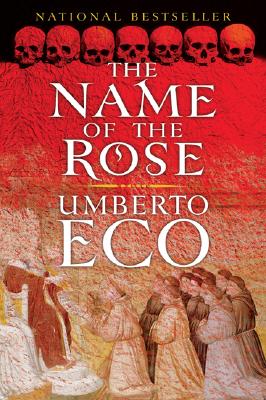
The first time I tried reading this book, I didn't get very far.  It starts by establishing a complex frame-within-a-frame structure detailing how the manuscript that makes up the main part of the narrative was found, lost, and translated.  This was a popular narrative technique in the era that Eco is trying to imitate, but as a modern reader it sounded a bit clunky.  This was followed by a vocabulary list in Latin describing how monks split up their days.  Even for a language-lover like myself this was a bit of a turn-off.  Then when the story did finally start the narrative style was difficult to get into.  It has different rhythms and structures than a typical modern narrative.  This was around where I gave up the first time.  I am very glad that I tried again, though.  The second time I kept reading long enough to get used to the narrative style and I could see why Eco wrote it this way.  It really helped immerse me in a period and world that was not familiar to me at all.  It was far more exciting than I thought the setting of a medieval monastery capable of providing.  The better book titles version of this would be called Monks Gone Wild.  If you want to know how to accuse someone of "breaking wind through the mouth" in Latin then this is the book for you!  The monks on these pages say and do things that would make a frat boy blush.  The plot underlying it all is a medieval Sherlock story of supernatural plots demystified and incredible deductions.  The action mostly takes place in a scriptorium and labyrinthine library where monks lust after books like flesh and are quite literally willing to kill for them.  The portrayal of the librarians was a bit disturbing to me, as well as almost everything the book said about women, but it was all accurate for the time period and so extreme as to be laughable now.  It's not an easy read, but it is well worth the effort and I'd recommend it to anyone with a good chunk of time to read far enough into the story to get used to the narrative and a fondness for thought-provoking arguments woven seamlessly in with scatological humor and action sequences.
The Name of the Rose by Umberto Eco: Buy it or check it out today!

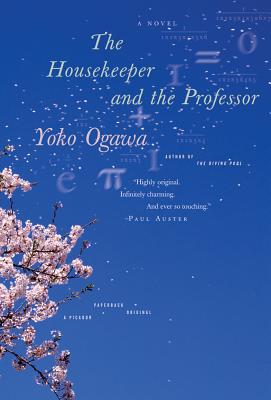
This quiet, short novel is unlike anything  I've read before.  The story centers around a housekeeper who gets hired to work for a math professor who's been in an accident causing him to have a memory that stops in 1975 and doesn't remember anything short-term for longer than eighty minutes.  This means that every morning the housekeeper introduces herself it is like he is meeting her for the first time.  There isn't much of a plot to speak of and there is a fair amount of time spent in discussing various mathematical principles and eventually baseball (neither of which are my favorite subjects) and yet I found myself gulping the novel down quickly.  I grew attached to the characters so quickly and they seemed so real that even though there weren't any major events happening to them I cared deeply about the everyday things that did occur as if I was hearing an update about a dear friend.  This is a great read for a summer afternoon, especially for teachers on break like myself.
The Housekeeper and the Professor by Yoko Ogawa: Buy it or check it out today!


Sunday, June 10, 2012

The Wikkeling Review


Book talk: Every house on Henrietta's street is identical: each one newly made of vinyl and glue with flat roofs sitting behind plastic lawns in their own soundproof and airtight cocoon.  Every house, except Henrietta's.  Henrietta's house is made of wood, with a sloping roof and an old-fashioned attic.  Henrietta's mother thinks that it must be some contaminant in their old house that is causing Henrietta's blinding headaches.  But Henrietta knows it isn't the house at all.  It's the Wikkeling.  Most people can't see the Wikkeling and Henrietta knows if she tries to explain it she'll only sound crazy.  Luckily she's found some allies, but will the neighbor boy, a kindergartener, and a Wild Housecat be enough to defeat the mysterious creature or will they all end up Finished?

Rocks my socks: I read this book at the end of long day when I was in a terrible mood, but from the very start Arntson made me forget all my troubles and took me away to a frightening and thought-provoking dystopia that nevertheless left me feeling far better than when I picked up the novel.  First off it started with a poem about a cat which instantly wins it points in my book.  Secondly it established the atmosphere and setting with wonderfully creative details like exhaust that is made to smell like lilacs to make the constant traffic jam more bearable and honk ads to take advantage of it.  Thirdly it introduces us to the main character Henrietta who is described as looking like a brick, "And yet Henrietta was not a stupid, confused, petulant block.  Or at least, she didn't feel like one.  Inside, she was just herself--a person to whom she'd scarcely yet been introduced."  The narrator then goes on to warn the reader: "She will not become beautiful when someone gives her a new hairstyle.  She will not find a miracle cure for her pimples when an angel sees she's a good girl inside.  She will not find out that she's actually a princess, and she won't become happy forever when a prince marries her.  Those books are out there, and your school librarian can help you find one.  This isn't it."  I know not everyone likes that kind of fourth wall destruction but when I read that passage I was completely sold.

A lot of time is spent on describing the school and as someone who works in an elementary school I found the descriptions eerily prescient and appreciated their warning about where we may end up if we are not careful--and isn't that what the best dystopian novels do?  I am lucky because I work in a really creative and wonderful independent school but I've had enough discussions with colleagues at more typical schools to feel a chill down my spine when I read about how the classes were more or less constantly preparing for the next standardized test with instant updates sent to parents on their student's progress via their cell phones.  Students who score poorly are marked as 'at risk' so that their score will not bring down the class average and if that happens twice they are 'finished.'  At lunch students sit in individual carrels and watch videos on history, the only non-graded period because history "wasn't related to anything"  (I knew that would make my history grad student sister cringe)  This period provided the delightfully dystopian quote "We must be courageous enough to look forward without fear, and sensible enough to fear looking backward!" When travelling to and from school students wear four seat belts on the bus: one lap, two shoulder, and a one across the head.  Even when they are sleeping a BedCam sends their image directly to the parents' bedroom for monitoring.

The novel is at times a dystopian commentary on society, at times a horror novel, at times a bildungsroman, and there's also plenty of humor infused throughout.  My personal favorite was the crosswalk where Henrietta "pushed the button and waited for the picture of the dead pedestrian to turn into the picture of the scared pedestrian."  I appreciated the logic of Henrietta when she's convincing a friend to do something dangerous: "We'll be careful...This kind of thing is the reason people invented carefulness in the first place."  Well said!  While we're on the subject of Henrietta's friends I love Rose and Gary.  I loved that in a society where kids who are Finished end up as garbagemen like that's the worst fate possible Gary actually is fascinated by garbage. I was all ready to be disappointed in the novel for disparaging the profession but I should have had more faith in Arntson.  Rose is a wonderfully precocious kindergartener who lives in a secret library so of course I love her.  I'd be remiss to end this review without mentioning Terrazzini's wonderful illustrations throughout, especially in the excerpt from the Bestiary which contains delightfully creative creatures that I'd love to learn more about (hint hint, wink wink, nudge nudge Arntson!)  The whole book is beautifully designed in fact from the binding to the layout to the endpapers.  It's definitely one you'll want a physical copy of to decorate your shelf once you're done with it.  You can go ahead and judge this book by its cover all you want!

Rocks in my socks: Nothing, I absolutely loved this novel and I'm very thankful to it for plucking me out of the deep, dark mood I was in when I started it.


Every book its reader: The novel is partly a horror story and while it's wonderfully creepy it's not actually that violent or gory.  I can definitely see some children getting nightmares from the Wikkeling (myself at a young age included but even Darby O'Gill ant the Little People gave me nightmares, so that's not saying much.)  Overall I'd say this novel is perfect to give to children who like horror stories to creep them out without being too violent.  It would be a good choice for kids who enjoyed Coraline or The Graveyard Book as it's no scarier than either of those and of a similar tone. Fans of the Lemony Snicket series will also enjoy this novel and appreciate Arntson's dark humor.  The dystopian setting gives older students and even adults plenty to ponder as well and it has a recommendation from James Dashner on the back which should be enough to sell it to my middle school students as half of them are obsessed with Maze Runner.  

The Wikkeling by Steven Arntson

Buy it or check it out today!

Thursday, March 8, 2012

The Scorpio Races Review


Book talk: "It is the first day of November and so, today, someone will die." It's time for the annual Scorpio Races where riders race on horses that came from the sea and long to return there.  Some horses may be overcome with this desire and run back to the surf, drowning their riders in the process.  Some may simply eat their riders, making the surf red with blood.  Some riders may be trampled beneath the horses' sharp hooves.  The races may kill several people, but they all ride anyway because no matter how likely it is that some will die at least one person is guaranteed to win.  So they race for all that they're worth--for fortune,  for fame, for glory, and for their lives.

Rocks my socks: It's so refreshing to see a young adult novel that's about supernatural creatures that aren't werewolves or vampires!  There is a dearth of kelpie literature out there which makes this book all the more special.  To make this book even rarer in the YA market it also doesn't have a love triangle in it.  I know, I was shocked as well.  Instead it has a really sweet romance where the characters get to know each other and help each other out and gain each other's trust instead of, you know, stalking each other or acting like a jerk.   The story alternates between both characters and each have a distinct voice and background that informs their actions.  Both are orphans, but on an island plagued by carnivorous horses that isn't all that rare.  The island is full of interesting characters and the tension remains high throughout as they train for the races that may give them their heart's desire or kill them.  I also love that it has a strong female lead in the form of Puck who is the first woman to ride in the races.  She's flawed, like all the characters in the book, but her courage and willingness to fight for what she wants is admirable.

Rocks in my socks: For a novel with a setting as harsh as this one's, the ending was a bit neat for me.  It wasn't tied-up-with-a-bow-on-top neat and if it was another novel I might not have this complaint but it wasn't another novel.  In this novel it's set up from the beginning that people regularly die and the island they all live on is a harsh mistress but worth the risk. A major source of tension in the novel is that both Puck and Sean have everything riding on the races and even though they love each other they can't both win. (highlight for slight spoilers)  But then in a way they both do. Objectively I was disappointed, but emotionally I must admit I was a bit pleased because I was so involved with the characters and I wanted them to be happy.

Every book its reader: The book is rather violent but no more violent than The Hunger Games and I've seen pretty young kids reading that.  Puck and Sean never go farther than a couple kisses but there is a bit of innuendo with one character turning up in the morning with lipstick on his collar and another commenting that that's why he doesn't look like he slept much and one character comforting another by saying that a year from now they'll have so and so in their bed (trying not to spoil too much.)  Those are the types of things that could easily pass over a reader's head unless they're old enough to get the references though so I wouldn't be too concerned about the book on that front.  All in all it depends on the kid but if they can handle Hunger Games then they should enjoy this novel.  Don't be fooled by the horse on the cover and give it to some third grader looking for a book about ponies though.

The Scorpio Races by Maggie Stiefvater

Buy it or check it out today!

Tuesday, February 7, 2012

Page by Paige Review


Book talk: Mr. and Mrs. Turner are writers, so naturally they named their baby girl Paige.  Paige Turner. But their daughter prefers to communicate through drawing.  It just goes to show that since birth, her parents have never understood her.  The only person who really knows Paige is her best friend, but now that her parents have moved the family to New York she feels like no one really knows her and she is completely alone.  So she decides to turns her artist grandmother's advice into rules to live by to create a new Paige.   Rule # 1? No more excuses! Buy a sketchbook and draw a few pages each week.

Rocks my socks: Even though I have never considered myself artistic in terms of drawing, Paige really resonated with me.  I can sympathize with the way Paige lives in her head, and I can draw inspiration from the way she sets and meets goals involving putting herself out there more.  I loved the game of drawing telephone they played (one person writes a phrase, next draws the phrase out and folds back paper to hide original phrase, next writes a phrase to match the picture, and so on.)  The visual puns delighted me (Paige's head as pages in a book when a boy can read her like one, a picture of her wringing her head like a towel and ideas dripping out, etc.)  In particular I found the guerilla artwork of Paige and her friends charming (quotes written in chalk on public stairs, faces and poems drawn on tulips, plastic eggs filled with objects and writing hidden around campus a month after Easter, etc.)  

Rocks in my socks: The ending is a bit too neat and perfect for my tastes.  It's inspiring that her efforts all turned out so well, but it seems a bit too pat and unrealistic.

Every book its reader: I'd give it to 6th graders and up looking for a coming of age story or a heartfelt, realistic graphic novel.  

Page by Paige by Laura Lee Gulledge